Trapped-ion quantum computing relies on the controlled interaction between an ion’s internal two-level structure and its quantized motion in the trap. By driving the ion with laser fields near the carrier and motional sidebands, we can engineer spin-dependent forces and geometric phase evolutions that form the essential quantum gates.
Monochromatic field
In Schrodinger picture, the Hamiltonian of the atom’s internal state and motional state is
The quantized motional modes can be in any specific direction (i.e., ax,ay,az), since they are three-dimensionally trapped. For example, if the incident beam comes from the x direction, the ions will consequently oscillates in the x direction, experiencing the changing of electromagnetic field with respect to x, thus only ax†ax are effective.
The coupling Hamiltonian describing the interaction between the ion and the electromagnetic field is
where x^ is the quantized position of ions in the Schrodinger picture, E=E0[ei(kx−ωt+ϕ)+e−i(kx−ωt+ϕ)] is a classical electromagnetic field running in the x direction (which implies the field itself is in the y or z direction).
/* Important: The electromagnetic field is not quantized! */
Introducing the Lamb-Dicke parameter η=k2mνℏ, we can rewrite the position operator as
δ=−ν, first red sideband, Hrsb(I)=iη2ℏΩ(σ†aeiϕ−σa†e−iϕ)=iη2ℏΩσ†aeiϕ+h.c.
δ=ν, first blue sideband, Hbsb(I)=iη2ℏΩ(σ†a†eiϕ−σae−iϕ)=iη2ℏΩσ†a†eiϕ+h.c.
Bichromatic Field
/* We will set the interaction picture as default. The superscript (I) will be omitted from now on. */
On-resonantly driven harmonic oscillator
Two superimposed laser fields at positive and negative detuning ±ν from a common center frequency, respectively, produce a bichromatic light field. The Hamiltonian is
Note: We only consider the superposition of the first sideband Hamiltonians in the expression above. In fact, the complete interaction Hamiltonian should be
Though carrier resonance term Hcar oscillates rapidly with frequency ν thus obliged to be omitted under RWA, it has larger order of magnitude Ω compared with sideband terms Hbic with an order of magnitude ηΩ. Therefore, the carrier resonance will cause infidelity. We will estimate its effect later. In the following discussion, we still use Hint≈Hbic.
Utilizing the relationship between ladder operators and Pauli operators
σ†=σx+iσyσ=σx−iσyX=21(a+a†)P=2i1(a−a†)
and defining the following parameters
ϕ+=2ϕb+ϕrϕ−=2ϕb−ϕr
the Hamiltonian of bichromatic light field could take these alternative forms:
where σϕ=σxcosϕ+σysinϕ is the Pauli matrix on the equatorial plane, with eigenvectors ∣+⟩ϕ and ∣−⟩ϕ pointing at (cosϕ,sinϕ,0) and (−cosϕ,−sinϕ,0) respectively on the Bloch sphere.
The evolution operator (in the interaction picture) is
where α=iηΩteiϕ−. /* The displacement operator is D(α)=exp(αa†−α⋆a). */
Off-resonantly driven harmonic oscillator
Two superimposed laser fields at positive and negative detuning ±(ν+Δ) from a common center frequency, respectively, produce a bichromatic light field. The Hamiltonian is
which is equivalent to a transformation with ϕb→ϕb−Δt and ϕr→ϕr+Δt. And ϕ+,ϕ− are consequently time-dependent
ϕ+=2ϕb+ϕr→ϕ+ϕ−=2ϕb−ϕr→ϕ−−Δt
The interaction Hamiltonian takes the form
Hbic=−ηℏΩ(aeiΔt−iϕ−+a†e−iΔt+iϕ−)σπ/2−ϕ+
where σϕ=σxcosϕ+σysinϕ is the Pauli matrix on the equatorial plane, with eigenvectors ∣+⟩ϕ and ∣−⟩ϕ pointing at (cosϕ,sinϕ,0) and (−cosϕ,−sinϕ,0) respectively on the Bloch sphere.
Since the Hamiltonian is time-dependent, we must use the Magnus expansion to calculate the evolution operator
Now, we must fix ϕ+ to ±π/2, which will lead to σπ/2−ϕ+=σx . Or, we fix ϕ+ to 0, which will lead to σπ/2−ϕ+=σy . The reason is that σϕ does not commute with itself, yielding a mix of σx,σy,σz when calculating commutator [Hint(t1),Hint(t2)].
We choose σx here. Then the first-order term and the second-order term are
Using Baker-Campbell-Hausdorff formula eA+B=eAeBe−[A,B]/2, we find the commutator term e−[A,B]/2 is actually zero. The evolution operator is simply the product of the first order term and the second order term.
The evolution operator can be decomposed into a displacement operator and a global phase
UI=D[α(t)σx]e−iΦ(t)
α(t)=ΔηΩ(1−e−iΔt)eiϕ−Φ(t)=(ΔηΩ)2(Δt−sinΔt)
For the displacement parameter, ηΩ/Δ controls the norm and eiϕ− controls the phase. The ion’s motion encloses a cycle in the phase space, with a period 2π/Δ.
For the global phase, at time t=2πN/Δ, the accumulated phase is 2πN(ΔηΩ)2.
The Pauli operator acting on the internal state space makes the displacement spin-dependent. For ∣+⟩x , the motional state will be displaced by α(t) . While for ∣−⟩x , the motional state will be displaced by −α(t).
Classical Picture: Driven Oscillator
Now we explain that, under the interaction between a bichromatic light field and an ion, the effect on the ion’s motion is equivalent to the forced vibration of a classical harmonic oscillator. Because the direction of the force on the ion depends on its internal state, this effect is also called a spin-dependent force.
First, let us review the model of a driven oscillator. Consider an undamped oscillator driven by a periodic external force F(t)=Fcos(ωt+ϕ). Its equation of motion is
mdt2d2x+kx=Fcos(ωt+ϕ)
Define the natural frequency ω0=k/m and f=F/m. Then the equation becomes
dt2d2x+ω02x=fcos(ωt+ϕ)
This is an inhomogeneous second-order differential equation. To simplify, assume both initial position and velocity are zero, the solutions are:
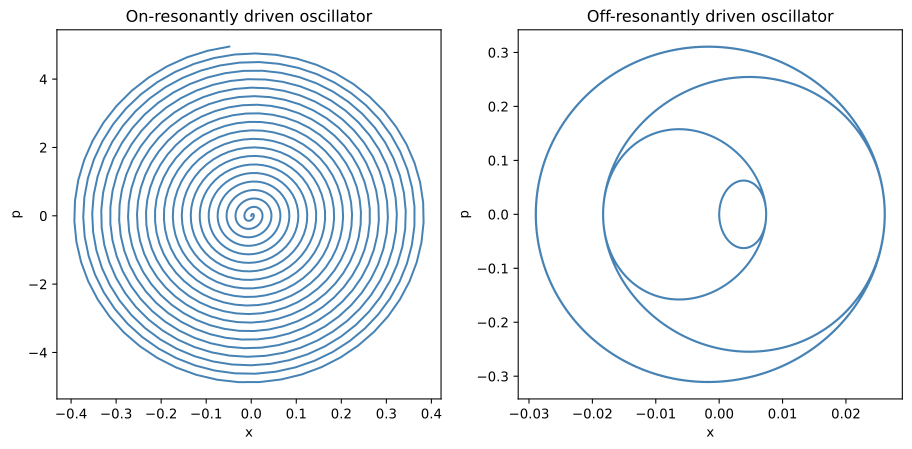
Resonant case ω=ω0: the position is x(t)=2ω0ftsinω0t, and the momentum is p(t)=2ω0f(sinω0t+ω0tcosω0t). The position and momentum oscillate while growing linearly in time.
Detuned case ω=ω0: the position is x(t)=ω02−ω2f[cosωt−cosω0t], and the momentum is p(t)=ω02−ω2f[ω0sinω0t−ωsinωt]. The oscillator’s position and momentum only oscillate periodically.
Plotting the trajectories in phase space yields the two distinct behaviors. One spirals outward from the origin, similar to the displacement parameter α behaving like iηΩt. The other repeatedly loops around the origin, similar to 1−e−iΔt.
However, these pictures are not fully clear because they include the oscillator’s dynamical phase, such as the sinω0t factor in tsinω0t. This causes the resonantly driven oscillator to follow a spiral rather than a straight line in phase space. By applying a low-pass filter that removes the intrinsic oscillation at frequency ω0 - analogous to transforming from the Schrödinger picture to the interaction picture in quantum mechanics - the resulting trajectories exactly match the expressions for α.
We may also describe the system using Lagrangian mechanics. The Lagrangian is
L=21mx˙2−21kx2+xF(t)
The Hamiltonian is
H=2mp2+21kx2−xF(t)
After canonical quantization,
H(S)=2mp^2+21kx^2−x^F(t)
Substituting x^→2mω0ℏ(a+a†) and p^→2mω0ℏi(a−a†), we obtain
H(S)=ℏω0(a†a+21)−mF2mω0ℏ(a+a†)cos(ωt+ϕ)
Define η=2mω0ℏ and Ω=F/m. Transforming into the interaction picture and applying the rotating-wave approximation yields
H(I)=−21ηℏΩ(aeiΔt−iϕ−+a†e−iΔt+iϕ−)
This is exactly the motional part of the effective Hamiltonian used for bichromatic light–ion interaction. We may therefore conclude: A bichromatic light field acting on an ion is equivalent to applying a periodic driving force to its motion, with the driving frequency equals the frequency of the light field. The only difference is that the direction of this force depends on the ion’s spin state. If an ion in state ∣↑⟩ is displaced in phase space by α under the bichromatic drive, then an ion in state ∣↓⟩ will be displaced by −α. That’s why it’s called spin-dependent force.
Summary
On-resonant bichromatic field
Hbic∼ηℏΩ(a+a†)σϕ
UI∼D(α(t)σϕ),∣α∣∼ηΩt
Off-resonant bichromatic field
Hbic∼ηℏΩ(aeiΔt+a†e−iΔt)σϕ
UI∼D[α(t)σϕ]e−iΦ(t)
∣α∣∼ΔηΩ(1−e−iΔt)Φ(t)=(ΔηΩ)2(Δt−sinΔt)
Second sideband
When considering the second sideband, the Taylor expansion of exp[iη(ae−iνt+a†eiνt)] is