In this article, we outline the essential experimental prerequisites for trapping and manipulating ions for quantum-information experiments.
Overview
Trapped-ion quantum information processing relies on confining single ions in a radio-frequency (RF) Paul trap, cooling them close to the motional ground state, and coherently manipulating their internal electronic states. Achieving this requires:
- An ultra-high vacuum chamber (to suppress collisions)
- A stable RF + DC trapping potential
- Photoionization lasers to generate ions directly inside the trap
- Doppler cooling lasers to localize and cool them
- A programmable electrode control system
Ultra-High Vacuum Environment
Ions can only remain trapped if the background pressure is extremely low, on the order of
so that the mean free path of residual gas molecules is effectively millions of kilometers. Any collision could heat or eject the ion.
Steps to reach UHV
-
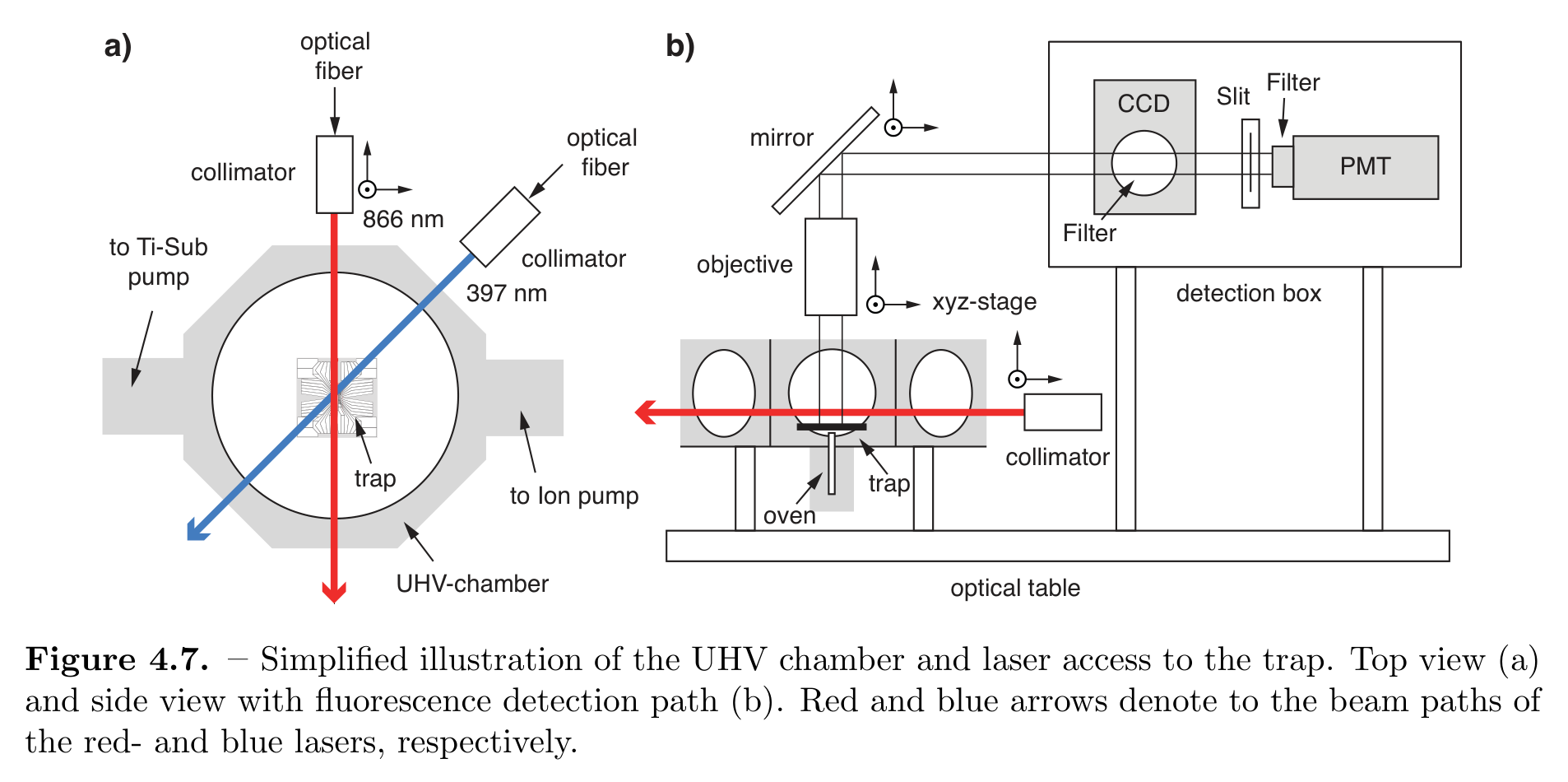
Place the ion trap in ultra-high vacuum (UHV) chamber
-
Lower the pressure of UHV chamber down to .
-
Bake the vessel for several weeks in an oven at reduce pressure to .
-
Connect with a residual gas analyzer (RGA) monitor residual volatile molecules.
-
Connect with an ion gauge to monitor pressure.
-
Use a titanium sublimation pump coat the inner surfaces of the chamber with a titanium layer.
/* Explanation: Clean titanium is very reactive, serving as a getter material. Sublimed titanium molecules can chemically react with reactive gases, like O2 and N2 , and disassociate and diffuse H2 . */
-
Use an ion pump to emit electrons and ionize residual molecules or atoms by collisions. The ionized molecules are then directed to and bounded by titanium layer, using strong magnetic field.
Maintenance: When venting, always use dry argon to avoid introducing moisture and oxygen.
-
Activating the Ion Trap
The RF and DC trap voltages must be switched on before any atoms or lasers are introduced.
Once the chamber reaches UHV:
- The RF drive is applied to the trap’s radial electrodes.
- DC electrodes are set to define axial confinement and micromotion compensation fields.
- The trap remains continuously on during ion loading.
Load neutral calcium
A resistively heated oven placed below the trap emits neutral calcium atoms
- A small piece of crystalline Ca inside the oven crucible is heated by current.
- A collimated atomic beam exits the oven and passes through a slit in the trap structure.
- Atoms traverse the center of the RF potential well.
Ionize calcium
-
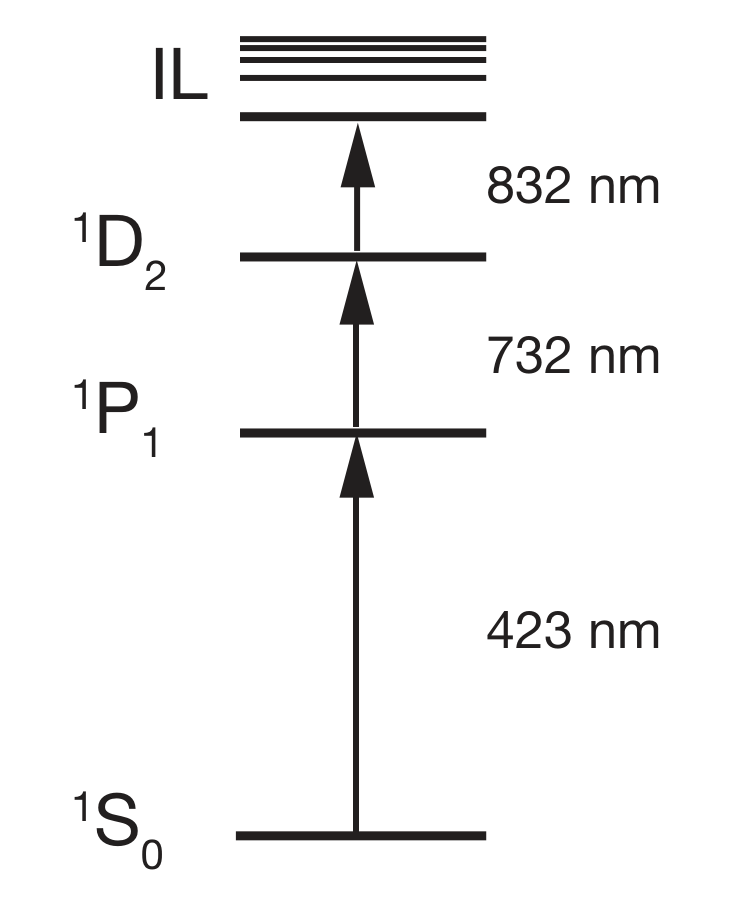
First, a blue laser excites the atoms from the ground state to the state.
-
Second, a red laser exciting to the state.
-
Last, a infrared laser is used for exciting the neutral atoms beyond the ionization limit of 6.1130 eV and creating positively charged ions.
/* Note: Spectroscopic notation */
Doppler Cooling
Right after an ion is created and captured by the ion trap, it has residual kinetic energy from the atomic thermal distribution in the oven as well as the recoil during photoionization. To confine and cool it, we use
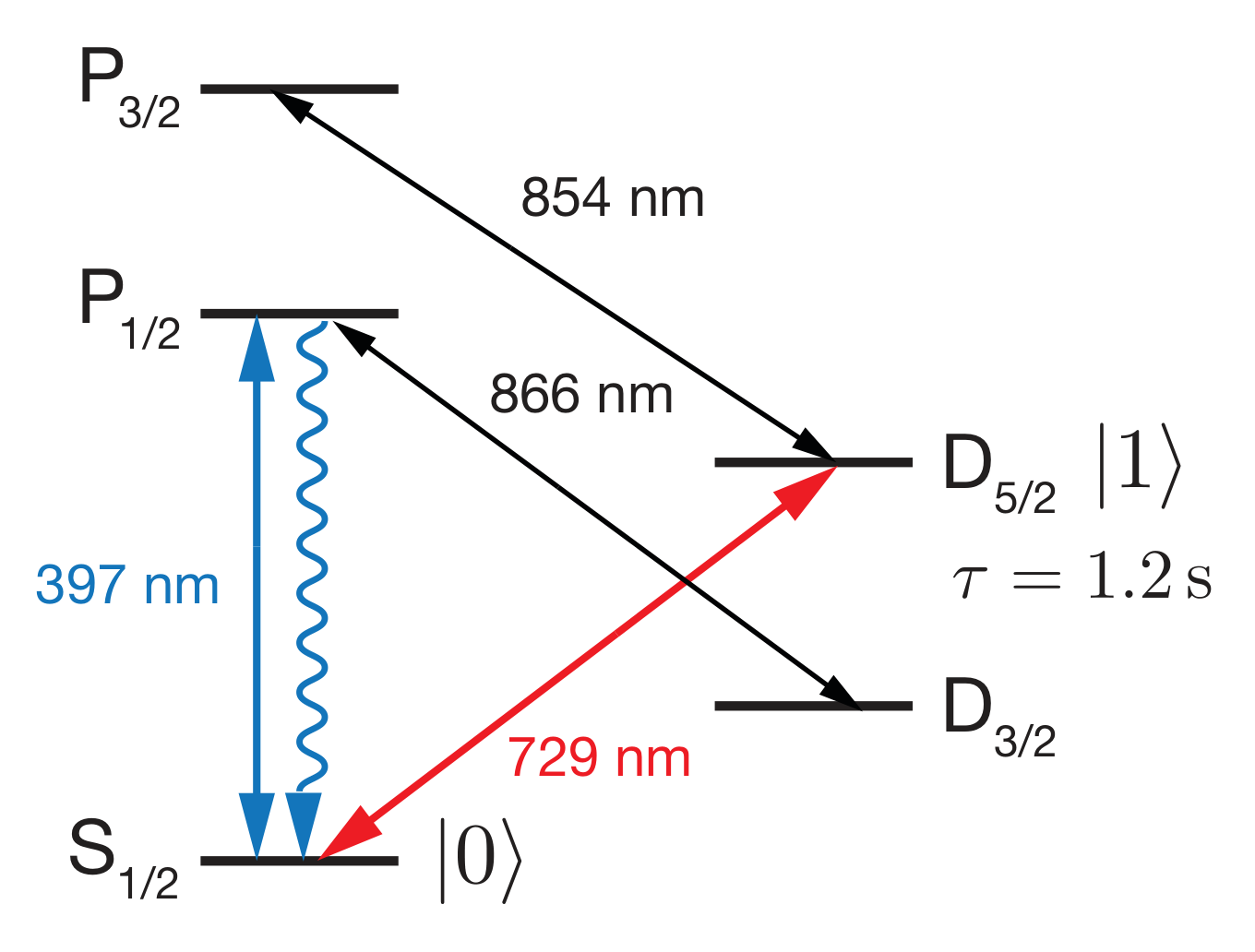
- A blue 397 nm cooling beam drives the cycling transition producing the Doppler cooling force.
- A infrared 866 nm repump beam clears population trapped in , maintaining a closed fluorescence cycle.
Fluorescence photons are collected by a PMT or an EMCCD camera, producing the characteristic bright image of trapped ions.