The Jaynes-Cummings model (sometimes abbreviated JCM) is a theoretical model in quantum optics. It describes the system of a two-level atom interacting with a quantized mode of an optical cavity (or a bosonic field).
Two-Level Atom Interacting with a Quantum Field
Jaynes Cummings model
The Hamiltonian of Jaynes Cummings model is
H=HA+HF+HAF=ℏω0σ†σ+ℏωa†a+ℏg(σa†+σ†a)
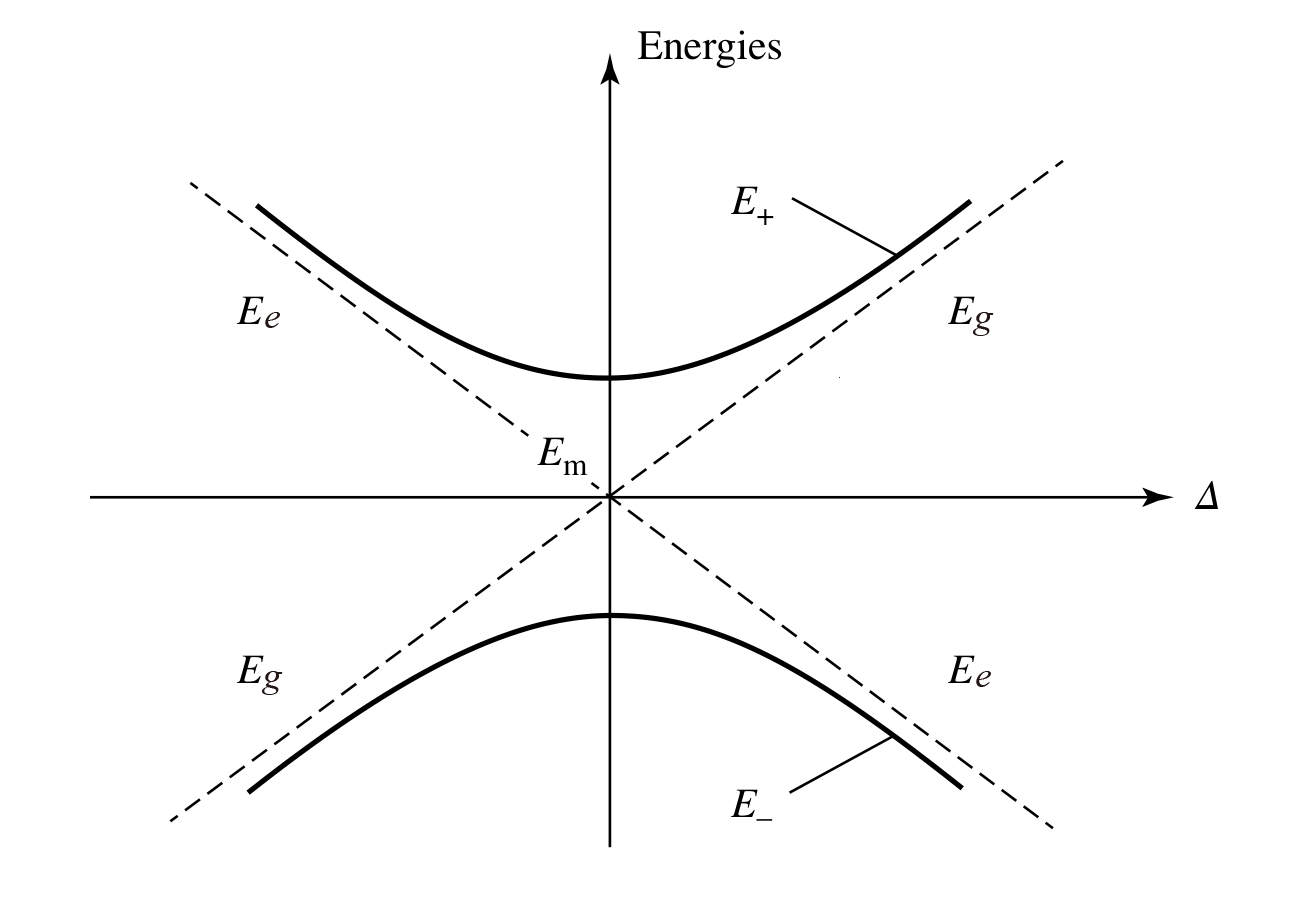
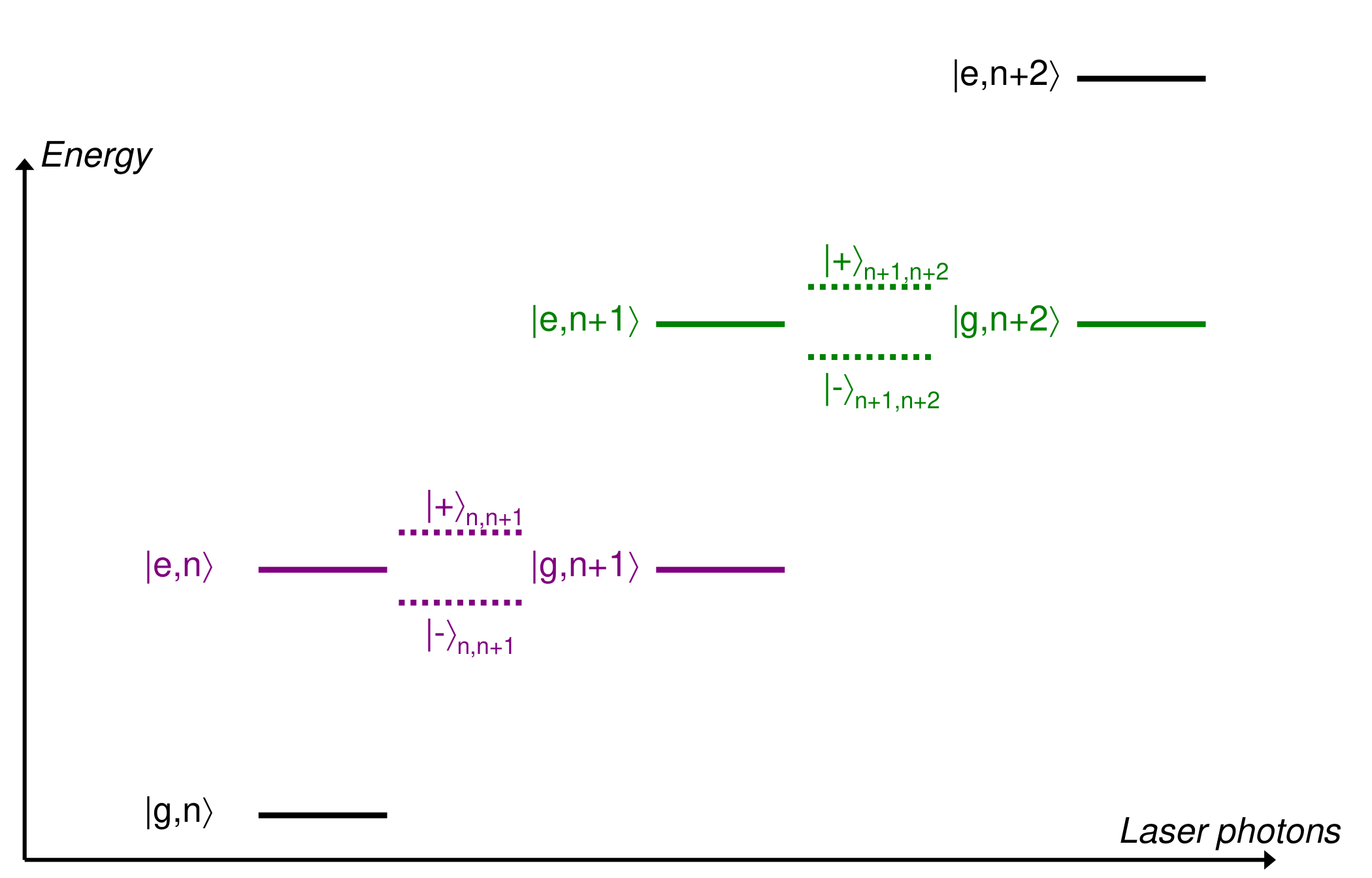
Only pairs of eigenstates ∣g,n+1⟩↔∣e,n⟩ are coupled, and thus the Hamiltonian is block diagonal, in 2×2 blocks, making it simple to diagonalize analytically
For large detuning∣ω−ω0∣≫g⟨a†a⟩ , the generalized Rabi frequency is approximately
Ωrabi≈ℏ∣ω−ω0∣
Therefore, when ω≪ω0 (blue detune), we have Eg≈E−<0 and Ee≈E+>0. While when ω≫ω0 (red detune), we have Ee≈E−<0 and Eg≈E+>0. Now, to perform adiabatic population transfer, we adjust the laser gradually and slowly from blue detune to red detune. Assume the atom was initially at ∣g⟩, and the laser is blued detuned, thus ∣g⟩∼∣−⟩. In the process of adjusting ω0, due to the adiabatic theorem, the atom will remain in the state ∣−⟩. However, when the adjustment ended, we find that ∣−⟩ sims ∣e⟩ now! The population transfers from ∣g⟩ to ∣e⟩.
Collapse and Revival
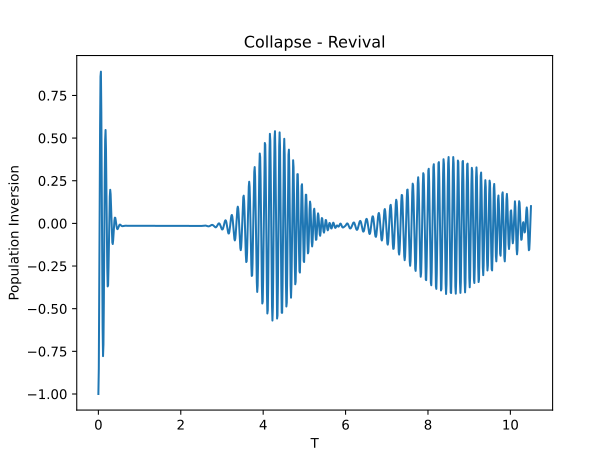
When an atom was initially at ∣g,α⟩, where ∣α⟩ is the coherent state, the phenomenon of collapse and revival occurs.
Large Detuning
In large detuning limit, the effective Hamiltonian is[1]
Heff=ℏχ[(a†a+1)∣e⟩⟨e∣−a†a∣g⟩⟨g∣]
where χ=g2/Δ and Δ=ω0−ω.
Mollow Triplet
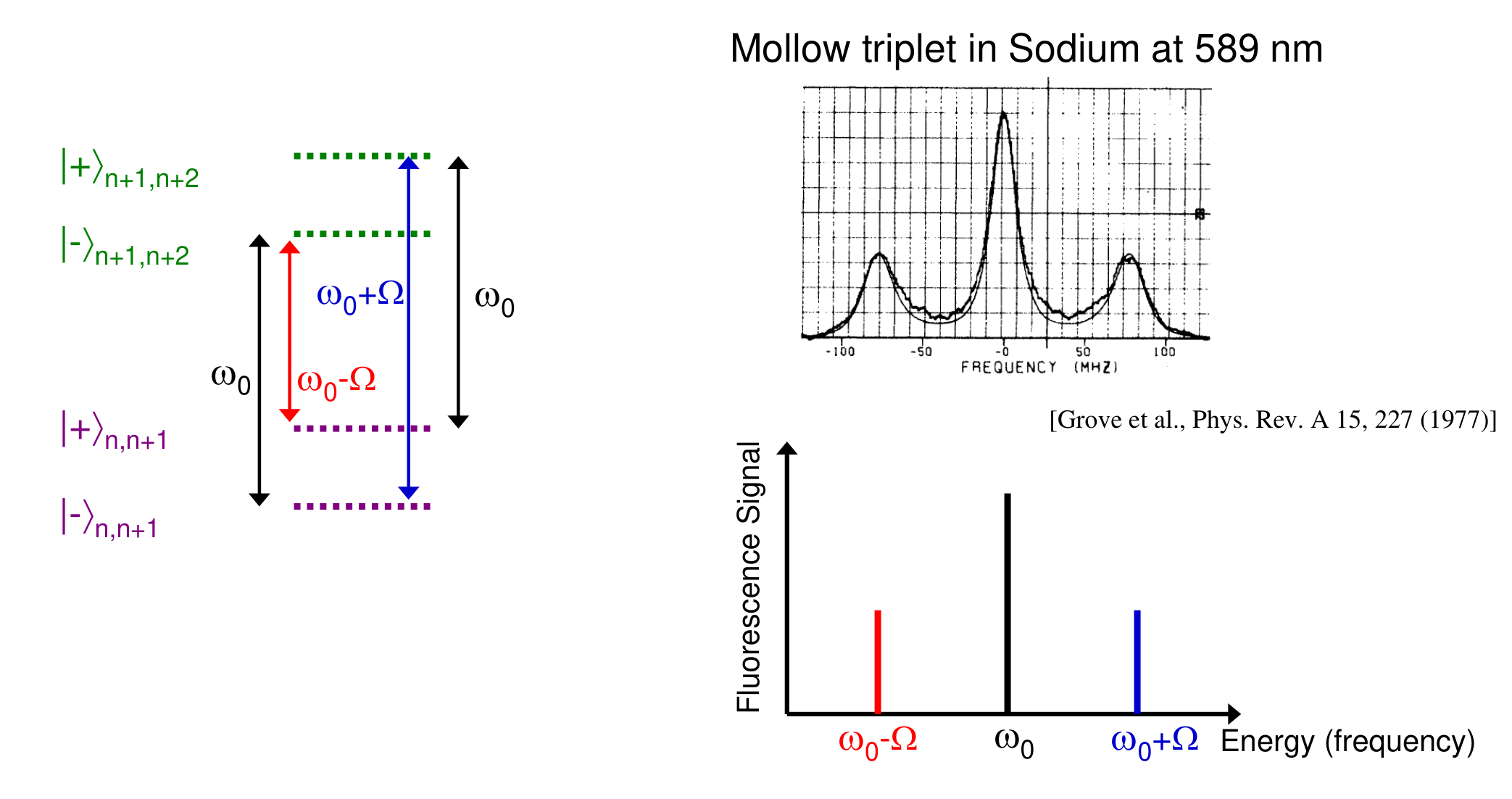
Mollow Triplet is the fluorescence spectrum when an atom is strongly driven by a laser. Due to the dipole interaction derived above, the atom-field system forms pairs of dressed states
∣+⟩n,n+1,∣−⟩n,n+1
whose energy splitting is set by the Rabi frequency Ωrabi. Spontaneous emission can occur between the dressed states of adjacent manifolds, and each pair allows three possible transitions
which give rise to the characteristic triplet observed in the fluorescence spectrum, with a central peak at the laser frequency (elastic scattering + small inelastic scattering), as well as two sidebands at ω+Ωrabi and ω−Ωrabi.
Gerry, C., & Knight, P. (2004). Introductory Quantum Optics. Cambridge: Cambridge University Press. doi:10.1017/CBO9780511791239 ↩︎