
A driven two-level atom exchanges energy with the field through stimulated absorption and emission, while spontaneous emission carries energy into the fluorescence and scattering channels. The rate-equation formalism provides an intuitive way to track population dynamics.
Two-level atom
Classical Model
-
: Number of atoms in per unit volume.
-
: Number of atoms in per unit volume.
-
: Spontaneous emission rate. Transition probability per unit time from to .
-
: Intensity. with dimensions .
-
: Absorption cross-section, defined such that is the energy absorbed by a single atom per unit time when irradiated by intensity with frequency .
-
: Rate of stimulated radiation. The probability of stimulated absorption equals the probability of stimulated emission, so that we can define such a shared rate.
/* Note: Although the probability is the same, the total energy gained from stimulated absorption and the total energy loss due to stimulated emission is not equal, since they are also proportional to and respectively. */
Einstein coefficient
The change in number of the excited atoms (per unit volume) comes from three processes:
-
Spontaneous emission: In a unit time, there is a probability of for a single atom to transition to . For atoms, the total transition number is .
-
Stimulated absorption: According to the definition of absorption cross-section, is the energy absorbed by a single atom per unit time. Since the incident beam has a frequency , each time the medium absorb a photon , an atom will be excited into (although the energy gap is ) . Therefore, in a unit time, is the total number of atoms in the state being excited into . That is to say,
-
Stimulated emission: Since stimulated absorption and stimulated emission have the equal probability, the mechanism is similar. We have a negative term .
The net rate equation becomes
For steady state, spontaneous emission + stimulated emission = stimulated absorption, . We obtain the steady state equation
Thus, the steady state of a two-level system always has , no matter how strong the incident beam is. Which means, it is impossible to use a two-level system as the gain medium of laser, since optical pumping cannot induce population inversion.
Intensity gain
When a laser beam with a frequency of and an intensity of is incident on the medium, we have
where is the gain of energy per unit volume per unit time caused by the net emission. Meanwhile, is also the gain of energy of incident beam per unit volume per unit time, where means stimulated emission minuses stimulated absorption, leaving the net gain of energy of incident beam. So
Combining and the steady state equation, we could derive
Lineshape function
We have found that for a fixed number of particles and a constant incident light intensity , the energy absorbed by the medium per unit time varies depending on the frequency of the incident light . This is reflected in the dependence of absorption cross-section on .
Furthermore, we can factorize as , where is the dimensionless lineshape function satisfying and is the frequency-independent cross-section.
Quantum Model
- : The probability of a single atom on the ground state.
- : The probability of a single atom on the excited state.
Solving the Optical Bloch Equation yields the steady-state excited state population
Define a saturation parameter , the above expression becomes
At resonance and high intensity (), the maximum excited state population approaches 1/2. It proves again that the steady state of a two-level system always has , no matter how strong the incident beam is.
Energy Flow
Now, let’s look at the key question: how does energy flow?
1 | Energ Input: |
When a laser illuminates a two-level atom, the atom interacts with the field through stimulated absorption and stimulated emission. The driving field induces transitions between the two states, and the resulting atomic dipole oscillates in phase with the laser. The portion of this coherent dipole radiation that couples back into the laser’s own spatial mode is what we call stimulated emission. It strengthens the transmitted laser beam and does not contribute to the scattered light detected outside the laser direction.
Alongside these stimulated processes, the atom also undergoes spontaneous emission, initiated by vacuum fluctuations. Spontaneous emission transfers energy from the excited state into the continuum of free-space modes. Experimentally, all radiation detected outside the laser spatial mode is therefore referred to as scattered light or fluorescence. From an energy-flow point of view, the scattered light is simply the spontaneous-emission channel of the atom in steady state, and its total power equals the spontaneous decay rate multiplied by the steady-state excited-state population , and a single photon’s energy.
Although arising from spontaneous emission, the scattered light still contains two physically distinct components:
-
Elastic scattering
-
This component originates from the steady-state dipole moment .
-
It produces a δ-like peak at the laser frequency and remains phase-locked to the driving field, which means it is coherent.
-
The driven atomic dipole radiates into all free-space directions with a dipole pattern. The part emitted into non-laser direction appears as coherent elastic scattering.
/* Note: The part radiated into the laser direction is exactly stimulated emission. */
-
-
Inelastic scattering
- This component originates from fluctuations of the atomic dipole .
- Inelastic scattering is incoherent.
- Under strong driving, the atom and field form dressed states, and transitions between these dressed states generate an inelastic three-peak spectrum, known as the Mollow triplet.
In conclusion, the same driven dipole produces three different radiative outputs:
- Stimulated emission – coherent dipole radiation in the laser mode.
- Coherent elastic scattering – coherent dipole radiation in non-laser modes.
- Incoherent inelastic scattering – fluctuation-driven radiation in non-laser modes.
Only the latter two constitute the observable scattered light.
Spectrum of resonance fluorescence
The optical Wiener–Khinchin theorem gives the scattered intensity
Using the far-field form of the dipole radiation operator , one obtains
where is the scattering spectrum per unit frequency with dimension .
The total spectrum satisfies the sum rule
which reflects that the total scattering rate equals , where marks the steady-state population of the excited state.
Define the normalized Lorentzian function that centers at with line width
We decompose the spectrum as
with
so that
To ensure that the total spectrum integrates to , the inelastic part must carry the remaining weight:
A convenient way to write this is
A striking feature is that the spectrum is centered at the laser frequency , not the bare atomic frequency . Under strong driving, the sidebands appear at , where is the Rabi frequency. This is the famous Mollow spectrum.
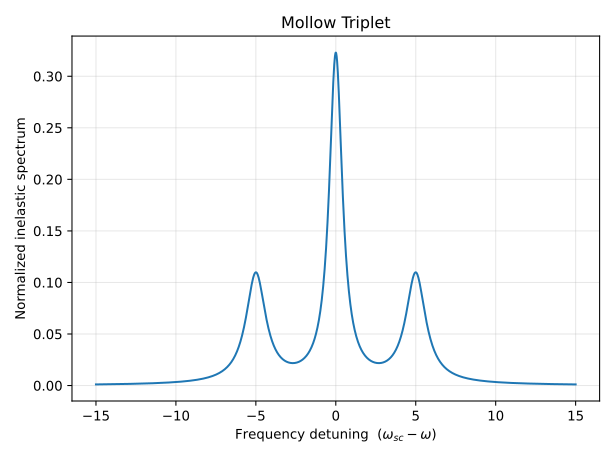
The total scattered power is obtained by integrating over all frequencies and directions
The result is interesting that, although the scattering spectrum is centered at the frequency of the incident photon , the total scattered power replies on the bare atomic frequency !
Power broadening
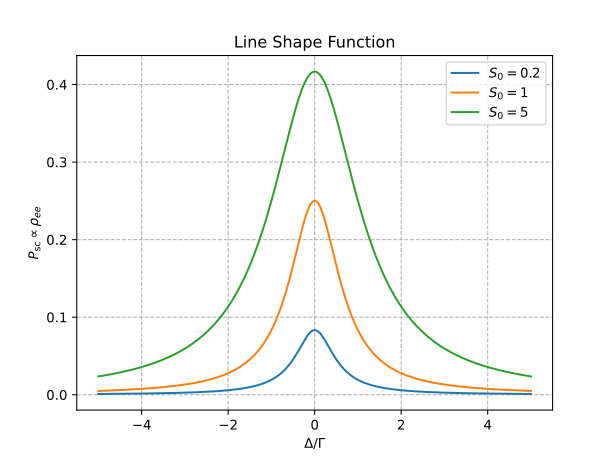
Therefore, measuring fluorescence power will allow us probe , since . The excited state population profile is
can be rewritten as
where defines the power-broadened linewidth. The full width at half maximum (FWHM) equals .
Two broadening regimes emerge:
- In the weak-field limit, , . This is called natural broadening.
- In the strong-field limit, , . The FWHM of fluorescence spectrum is effectively larger due to the strong coupling to the field. This phenomenon is called power broadening.
Classical-Quantum Correspondence
Warning: This correspondence holds only at resonance .
Optical Bloch Equation writes
Naturally . Recall that in classical model
comparing the coefficients, we obtain
Since
The absorption cross-section now becomes
where and we have applied the on-resonance condition . Notice that
is the normalized Lorentzian lineshape function, hence we rediscover the result from the classical model
where is the lineshape function and is the frequency-independent absorption cross-section.
We can obtain the same result using the energy conservation relation
Again, this proves the consistency of classical and quantum model at resonance.